Showing posts with label Clogging. Show all posts

Tuesday, 24 November 2020

Looking Back At the Rich History of Wooden Clogs

Swedish wooden clogs have been around since a long time. Archaeological records have dated the oldest surviving wooden clogs to as early as the 1200s. While these may be the earliest recorded usage of clogs, archaeologists, citing various historical evidences such as paintings have determined that wooden footwear were extensively used during the Roman Empire (27 BC – 395 AD).

Clogs in Early Europe

Although it were the Dutch and the Swedish who were mostly responsible for popularizing wooden clogs in Europe during the 1200s , they didn’t gain momentum in other areas of the world mainly due to their dull appearance.

Why Wooden Clogs?

Even though other shoe-making materials, such as leather were available, wood was mostly used to make shoes because:
  • Wood was readily available from trees.
  • It was much easier to carve solid wood into shoes rather than stitching shoes from leather.
  • Wood is very strong, hence it offered better protection to the feet.
  • Wood is very durable, hence wooden clogs lasted much longer than other footwear.

Clogs after World War II

There was a surge in the popularity of clogs after World War II, which saw the introduction of Swedish wooden clogs to the western world. It were the high-heeled fashion clogs that gained popularity in the United States and other parts of the world, where wooden clogs were virtually unheard of.
Famous celebrities and cultural icons, such as Audrey Hepburn started wearing clogs in their movies and promotional shoots, which further helped clogs gain a solid foothold in the United States and become popular among women all over the country.

Redesign of Clogs

Early clogs were solid blocks of wood that were carved into shoes as functionality was given greater preference over looks and aesthetics.

The redesigned Swedish wooden clogs, which were introduced in the 1970s had the perfect balance of style, design and functionality, and this was the main reason why they became popular worldwide.
 
High-heeled variants of clogs were designed especially for women, although unisexual variants were available for both men and women.
While early clogs were made only of wood, modern clogs started combining other materials such as leather, rubber and synthetics with wood for better looks. This also enabled manufacturers to make countless designs using the common wooden base.

Are Traditional Clogs Still Used Today?

Although fashion clogs have been derived from traditional clogs, the latter are still in use today in parts of Sweden and Holland as the traditional footwear for local festivals and important traditional events.
Most of the world sees clogs as a fashion footwear, but they are still considered as an invaluable part of central Europe’s age-old traditions.

Tuesday, 30 June 2020

New to World of Clogs? Here’s How to Make Your Unique Style Statement

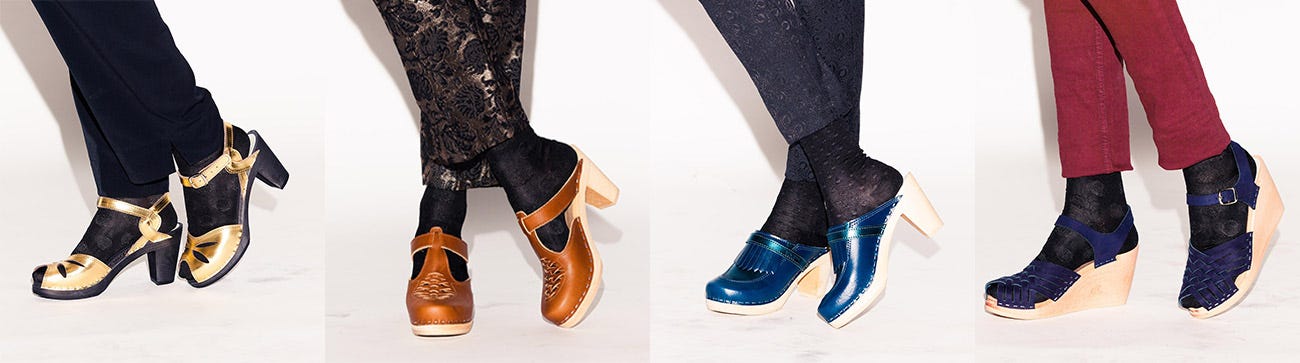
Marilyn Monroe aptly remarked, “Give the right shoes to a girl and she will conquer the world”. And when it comes to blending style with comfort, the type of shoes one can bet upon is Swedish wooden clogs. The clog industry is ever-changing, with every new season pouring in new styles. In this dynamic arena, it is quite bewildering for someone who is new to the world of fashion, particularly shoes, to choose the right kind of shoes. Contrary to the earlier perception, clogs offer a plethora of designs and materials. So, to make it easier for a newcomer into the fashion of clogs, having a passion to adorn the trendsetter clogs, here are five simple and easy-to-implement steps using which one can develop the art of making perfect combinations of dresses and clogs.


Make Fashion Magazines Your Bible

Magazines are full of latest style trends in anything and everything related to fashion. So, follow a couple of good magazines religiously that will help you know what is hot in the market. Taking guidance from there, you can incorporate trendy items in your closet.

Subscribe to Your Favorite Stores for E-mails

Sign up right now for having up-to-date of what is trending. As these stores have the first exposure to the latest manufactured and demanded stuff, following them can be of a great help. One can also avail discounts on them for on various new items.

Follow Blogs of Stylists and Fashionistas

If you will follow the blogs of fashionistas and stylists, you will not only be enlightened about what kind of clogs go well with what kind of attire, but you will also come to know about in-depth knowledge of what kind of materials to look for, what kind of textures and designs are popular and long-lasting. Just follow them and use your own creativity to have a happening collection of stylish Swedish wooden clogs, the most comfortable kind of clogs one can have.

Window Shopping

Although it is an old-school method, yet it is a tested way of upgrading yourself with the latest fashion trends in clogs that are ruling the market. You need not necessarily buy all the stuff, just have a glance so that to get an idea of what would be suitable for you. And you know what, this method will not even cost you much.

Lookout for Sale Events

It is not only important to watch out the latest trends and add to them to your wardrobe, but also one should have an idea of the budget one can afford. Be a smart shopper and the way to do is none other than to look out for sale events. Here, one can get the best things at pocket-friendly prices. The good news is that many of the sale events regularly have Swedish wooden clogs on sale.

Thursday, 31 December 2015

Clogging: A Dance Form That Will Always Remain In Trend


Clogging (dancing on wooden clogs sandals) is a traditionalfolk dance whose roots may be found in the European dances from the British Isles. Historically speaking, clogging was done to socially unite people in the Appalachian Mountains as early as the 1300s.


Since then, the clogging style of dance has been diffusing in various culture and has been enriching their celebration of the art of dancing. Various communities has accepted this dance form with open arms and added their own variations it. In the early 1400s, as clogging was migrated to England, the leather topped shoe replaced the wooden clogs. The modification went on further in 1500s, with wooden heels being attached to the leather shoe itself.   

Later on, the word clogging was replaced with more contemporary names like flat-footing, foot-stomping, buck dancing, clog dancing, jigging, or other terms popular among the local people. Through all these terms the primary emphasis was laid upon the prolific use of footwork. Also, many old fashioned clogging shoes were made entirely from leather or velvet, with wooden soles.  

Clogging shoes comprise of jingle taps. There are four jingle taps on each shoe, two of them on the heel and the other two on the toe.  One of tap is permanently fixed and the other one is loosely fastened. The loosely fastened one hits both the floor and the fixed tap while performing, or simply walking.

Tradition of clogging in USA

The roots of clogging in the U.S can be found in the Appalachian region and the Ozarks. In U.S, it is believed that bluegrass, which is based on Scots-Irish tunes of the Violin, is an offshoot of clogging.  

Popularly known as buck dancing in America, it was brought into trend by the minstrel performers in the late 19th century. Buck dancing became a source of charm for numerous festivals and fairs. The word buck originates from bockorau that can be traced to an Angolan word buckra, used to signify the white people. According to some sources, buck was a jig dance that was performed by the Irish immigrant sailors. 

Talking about the modern form of clogging, it is in assimilation of its traditional but is performed to a myriad styles of music ranging from bluegrass, modern country, rock music, pop, and hip hop. Today, competitive clogging competition are being held in the entire United States, majority being held in southeastern states. Also, there has been a shift from the flat foot dancing to dancing on the toes.